quarta-feira, 4 de maio de 2011

domingo, 24 de abril de 2011
quinta-feira, 7 de abril de 2011
segunda-feira, 4 de abril de 2011
quinta-feira, 24 de março de 2011
sábado, 19 de março de 2011
terça-feira, 8 de março de 2011
sexta-feira, 4 de março de 2011
segunda-feira, 28 de fevereiro de 2011
sexta-feira, 25 de fevereiro de 2011
terça-feira, 22 de fevereiro de 2011
quinta-feira, 17 de fevereiro de 2011
segunda-feira, 7 de fevereiro de 2011
sexta-feira, 4 de fevereiro de 2011
terça-feira, 1 de fevereiro de 2011
Candy Tongue Painting Experiment #1
This idea comes from Wreck This Journal by Keri Smith.
Candy: Wonka Everlasting Gobstopper
In box: Red, Orange, Green, Purple, Yellow.

It took me a little while to figure out why I couldn’t get the color to show up on the page. I discovered that you can’t suck on the candy for more then a few seconds before you put your tongue on the paper. That is when the color pigment is the strongest. Don’t get lost in the flavor 
I’d like my next one to be with different types of candy mixed together so I can play with texture and different color shades/levels of brightness etc. And maybe instead of just pressing my tongue onto the page actually making a recognizable image using this method <3

and for fun

My tongue feels really fucking weirdnow, and the front of my head aches a little.
Another downside to painting with large amounts of sugar
I spit them out into this baggiewhen they lost color.
See my pathetic little used, whore candy:

Hearts & Butcher Knives,
quinta-feira, 27 de janeiro de 2011
Ah hum
Leaving Facebook:
The great digital media death from an artist networking standpoint:
Thoughts?


are we locked into our facebook accounts due to our creative networking/careers?
Is this a negative thing? What would the negative aspect be/what would the positives be?
Is facebook the end all be all of networking at this point in time?
do people care about you or pay attention if you are not on facebook?
should said artist care of the latter?
Share your thoughts.
It would be much appreciated.
domingo, 16 de janeiro de 2011

sábado, 15 de janeiro de 2011
The Centro Cultural de España in Lima.
 Boobies!!! A whole wall of them. The piece is titled Muro, 2009 by Raquel Paiewonsky. (Photos by C-M.)
"While my mission on this trip to Lima has been to eat and to eat again, I have managed to sneak in a few visits to art galleries between degustaciones. The best show thus far has been an exhibit of contemporary Dominican art that I happened to catch at the Centro Cultural de España on the Plaza Washington, near downtown.
The show, Mover la roca (Move the Rock), features new works by the D.R. arts collective Quintapata, whose members are Tony Capellán, Pascal Meccariello, Raquel Paiewonsky, Jorge Pineda and Belkis Ramírez. Overall, a highly interesting show. And way better than the couch art I’ve been admiring at many of the city’s commercial art galleries."
quinta-feira, 6 de janeiro de 2011

The photo above was taken by Eugene Richards. Sgt. José Pequeño suffered a devastating brain injury from a grenade tossed into his Humvee in March 2006.
“In his mother’s arms, I hardly recall a more visceral sensation of the senselessness of the Iraq campaign. Given the angle, Pequeno’s brain injury draws an unavoidable analogy between war and the capacity for thought. Ultimately, there is no rationalizing or comparing one devastating form of injury with another. In Sgt. Pequeno’s case, however, the war has literally caused him to lose his mind.”
(via thechocolatebrigade)
quarta-feira, 29 de dezembro de 2010
10 more reasons to love riot grrrl
You can say that it’s crappy, unoriginal, overtly angry, overtly angsty, redundant or even narrow-minded, but… you’d be wrong.
1. Riot grrrl’s non-exclusive, welcoming philosophy is one that stands in stark contrast to almost every other punk scene – ever. Clothes, hair and every other sort of cred-generating physical feature were irrelevant; anyone who cared about women’s rights and a girl powered revolution could be part of the “scene” without facing scrutiny.
2. Artistic mediums were smashed together into DIY experiments that never so much as looked at getting major label, “corporate” exposure. ‘Zines churned out on photocopiers and albums recorded in closets cycled through the riot grrrl community and found thousands of fans without ever feeling the need to sell out, give in or defy any other part of the indie-punk fantasy.
3. Kathleen Hanna. Enough said.
4. Teenage girls were taken seriously without surrendering their adolescence. Riot grrrl didn’t force teenagers to stop caring about things like boys and hair and the mall, it merely acknowledged the social pressure to be interested in those things and the detrimental effects.
5. Riot grrrl’s cheeky spin on “lipstick” feminism made it cool to be an enlightened, empowered female… who shaved her underarms. The archetypal, stereotypical vision of an “ugly” man-hater could be rendered obsolete at last.
6. Feminism finally made sense to teenagers. I know that I was never much interested in first or second wave stuff. But then, suddenly, Carrie and Alison and Kathleen were making punk records and fanzines, and it was interesting, and as an angsty 13 year old, it felt worth it.
7. ‘Zines provide a creative outlet like no other. I never really appreciated how fucking GENIUS some of them are until I started working on my own. It is not easy. It is much, much harder than blogging but at the same time it’s like the most intellectual arts ‘n crafts project ever, and it’s funnn.
8. Predecessors like X-Ray Spex, the Raincoats and Joan Jett got credit. Riot grrrls never denied their influences.
9. Say what you want about the quality of the music, but it has staying power. I know way more riot grrrl fans (do keep in mind that I tend to join groups and clubs and lists of “Feminists on Tumblr”, of course) than I do fans of like, 90′s electronic. It’s just a lot more exciting and inspiring and, sometimes, catchy than other musical scenes.
10. As Kathleen Hanna once said, “We’re not anti-boy, we’re pro-girl.” Riot grrrl never asked fans to hate men or exclude them, it just provided a venue and a safety net so that girls could be themselves and look at life without bias piled on by having only males be influential. There were even a fesexta-feira, 24 de dezembro de 2010
France Gall - Poupée de cire poupée de son
Je suis une poupée de cire
Une poupée de son
Mon coeur est gravé dans mes chansons
Poupée de cire poupée de son
Suis-je meilleure suis-je pire
Qu’une poupée de salon
Je vois la vie en rose bonbon
Poupée de cire poupée de son
Mes disques sont un miroir
Dans lequel chacun peut me voir
Je suis partout à la fois
Brisée en mille éclats de voix
Autour de moi j’entends rire
Les poupées de chiffon
Celles qui dansent sur mes chansons
Poupée de cire poupée de son
quarta-feira, 15 de dezembro de 2010
20 razões para ser feminista
1 – Porque puta é o adjectivo que descreve uma mulher que tem o mesmo desejo sexual que um homem.
2 – Porque a mutilação genital ainda é uma realidade.
3 – Porque em Portugal os trabalhos domésticos e os trabalhos considerados de cargos inferiores continuam a ser maioritariamente das mulheres.
4 - Porque dois terços dos analfabetos no mundo são mulheres e raparigas.
5 – Porque o feminismo nunca matou ninguém ao contrário do machismo que mata todos os dias.
6 – Porque a violência doméstica nas mulheres e crianças é uma realidade nos dias que correm.
7 - Porque toda a mulher já sofreu insultos na rua, no carro.
8 - Porque toda a publicidade sexista que nos rodeia mete nojo e a forma como degradam as mulheres.
9 - Porque somos solidários(as) com as mulheres e as raparigas, que aqui ou algures, são maltratadas, humilhadas, insultadas, violentadas, violadas.
10 – Porque queremos um mundo de direitos de igualdade e dignidade e que esses direitos sejam aplicados.
11 - Porque a sexualidade deve originar um prazer recíproco e não ser usada para sujar ou insultar.
12 – Porque ninguém manda no corpo da mulher.
13 - Porque 99% das terras cultivadas no mundo pertencem a homens, apesar de as mulheres produzirem 70% das culturas alimentares. Porque as mulheres são 70% das mais pobres no mundo.
14 - Porque o mundo machista e sexista em que vivemos menospreza as mulheres, homossexuais e as crianças.
15 – Porque cozinhar não tira a virilidade ao homem.
16 – Porque pedimos que uma lei contra o sexismo seja o modelo da lei francesa anti-racista de 1972, afim que os delitos e os crimes sexistas sejam reconhecidos como tal e punidos.
17 – Porque a toda a mulher é livre de escolher o companheiro.
18 – Porque ainda não existe liberdade de expressão.
19 - Porque os feministas fodem melhor.
segunda-feira, 13 de dezembro de 2010

quarta-feira, 8 de dezembro de 2010

terça-feira, 7 de dezembro de 2010

segunda-feira, 6 de dezembro de 2010

sexta-feira, 3 de dezembro de 2010

quarta-feira, 1 de dezembro de 2010

domingo, 28 de novembro de 2010
UR ATTENTION PLEASE!
here's what i'm looking for:
articles/stories on any of the below topics:
* how you first discovered riot grrrl
* what riot grrrl means to you
* how riot grrrl has helped you and your grrrlfriends
* how has riot grrrl/feminism changed the world in your point of view
* important issues that still need to be fixed
* grrrl love
* stomping out grrrl hate
* being a grrrl in the punk rock scene
riot grrrl manifestas
comics
artwork
cd/book reviews
grrrl bands in your area (if possible, include link to their site/myspace/facebook/etc.)
you're also welcome to include photos of you and your grrrlfriends to accompany your articles/stories!
here are some examples of what we are looking for: the “click” moment when you realized you do or don’t identify as a feminist; growing up with/without feminism in yer life; stories from childhood, inspirational people (in yer families, culture, literature, etc.); introduction to women/trans/people of color’s work & theories in high school/college/etc.; relationship to past feminist movements (first wave, second wave, third wave, riot grrrl, etc.); in-depth essays about feminists of the past; history of witches, the clitoris, scientific/religious/philosophical views of female sexuality; past feminist movements that might not be well known (in africa, south america, etc); looking back to compare the state of women now to the state of women in the past; what you foresee in the years to come; what your ideals are for the years to come; HIV/AIDS and the queer movement; the importance of preservation for queer/POC/trans/disabled groups; social constructions of sexuality, race, gender, etc.; what it means for you to be a survivor of sexual assault (even a story about yer assault); the history of yer hair (POC & having “natural” or chemically straightened hair / the decision to stop shaving body hair in relation to feminist politics); having an “alternative” family (gay parents, adopted, cared for by grandparents, living in foster care, etc.)
also, we really need artwork! individual drawings, paintings, collages, or comic excerpts are all desirable! if you need more time to come up with something, or will be unavailable to mail us something before then, e-mail us and we can work something out!
all submissions can be sent to: riot.girlz@hotmail.com
sábado, 27 de novembro de 2010

quinta-feira, 25 de novembro de 2010

terça-feira, 23 de novembro de 2010

segunda-feira, 22 de novembro de 2010

domingo, 21 de novembro de 2010
Rebel Girls: Asking Sara Marcus about Girls to the Front: The True Story of the Riot Grrrl RevolutionDespite my familiarity with the American undergro
Sara Marcus’s new history, Girls to the Front, reclaims Riot Grrrl as something much more important and complicated. Riot Grrrl emerges as a movement of girls seeking to redefine feminism using, in part, the ethics and techniques of punk and indie rock. Through zines, activism, meetings, art, and community, as well as fashion and music, riot grrrls seized some space in their own lives, as well as at the front of the crowd at rock shows—turf usually dominated by moshing boys.
Marcus tells the story in a counterpoint that is simultaneously with the girls pounding furiously at typewriters and trap sets, and mellowed with age, perspective, and erudition. The book includes poetic and insightful analysis of the music and zines (“…‘Rebel girl rebel girl rebel girl you are the queen of my world,’ sung-chanted to a beat that could govern a drill line of revolutionaries in vulva-shaped berets…. With this incantation, the girls raise the shade of the role model, the someone they’ve been longing to see…. They make of each other that girl. They make her themselves.”), and also reflections on what was so vital about Riot Grrrl and what broke it up.
I asked Sara a few questions about Girls to the Front over e-mail, and her responses are really sharp. Read on:
1. Even before your DIY exhortation in the Epilogue, I found myself pausing my reading to pull my guitar out of the closet and play for the first time in a long while. How did you do that? Or, not to take credit away from you, how do you think the story of Riot Grrrl inspires that get-off-your-butt enthusiasm?
Josh! I’m so glad that the book got you to pick up your guitar! One of my favorite e-mails I’ve received so far is from a young woman who wrote “It kind of hurts to type right now because I decided to start playing guitar.” Yes, this effect is a result of a sort of collaboration between me and my material. I very consciously sought to tell this story not in the conventional rock-history mode of “Here were these amazingly special souls who made magic things”—not at all to diminish the gifts and talents and vision of the people in the book, which are considerable—but rather as a story about how valuable it is for everybody to make things that they’re passionate about, even if they’re not “the best.” This was a central idea of Riot Grrrl, one that had a lot to do with the permissive DIY spirit of the punk scene in Olympia, Washington. That scene was all about encouraging everybody to make whatever they could make, rather than leaving music to the Real Musicians and writing to the Real Writers. For people who are a little overachievery, and particularly people who live in a major city like New York, where there’s so much greatness at every turn, it can be hard to maintain a hold on what’s to be gained by doing something creative just for the love of it, and I’m glad the book seems to be helping people to pay attention to the value of simply creating something and being part of a conversation with a community.
2. Compared with other subcultures, it seems that Riot Grrrl had vastly less time to mature in the underground before getting shoved into the spotlight. The predominantly male punk/indie rock scenes had a good share of the ’80s to develop their codes and culture before Nirvana came out, whereas Riot Grrrl got almost immediate attention, as you lay out in the book. Was this just bad luck of Riot Grrrl’s happening to appear just before punk broke—or do you think it was somewhat inevitable in our society that a girl movement would, like the girls themselves, be objectified in its early adolescence?
I love the elegant parallel you draw, but I think the timing—the fact, for instance, that Nevermind came out two months to the day after the first Riot Grrrl meeting, and went gold two days before Nirvana and Bikini Kill played a show together in Seattle (it went platinum a couple weeks after that)—actually had a much greater impact on how quickly the media latched on to Riot Grrrl. Adolescent girls are easy objectification targets for media, sure, but condescension and dismissal are even stronger forces. Narratives about hysterical, passive girl fans (see: Justin Bieber) or puerile girl rebels are usually the trump cards in media coverage of young women (unless the young women are predominantly poor and/or not white, in which case of course entirely other narratives hold sway). What I’m getting at—and this is all highly speculative, of course—is that I don’t think the media would have known how to see these young women as cool or important had they not been linked (by geography, by scene) to a male phenomenon that was already seen as cool and important.
3. That mainstream media attention was profoundly damaging to Riot Grrrl, but as you reveal in your Author’s Note, it was a Newsweek article (which one girl called “the worst possible thing that could have been written”) that threw you a lifeline as a teenager. Is there any way to resolve that contradiction? Was it worth it for the most idyllic form of the movement to be martyred so it could save a much greater number of girls?
It’s true: Some people hated the Newsweek piece and felt really hurt by it, while I and others were inspired by it and drawn to the movement by it. Same thing with the Spin article—the experience of working on that piece led many of the DC girls to swear off media forever, but the group in Vancouver, BC, started directly as a result of some girls reading that article.
I’m going to go out on a limb, and perhaps offend some people, by saying this trade-off was worthwhile, because if you look at the stated goals and vision of those participants in that earliest “idyllic form”—getting more girls to start bands, to talk to each other about sexism, to save their lives and one another’s lives—the media attention really helped that to happen. Of course it’s lamentable that the media attention sullied the experience for other people, and the distortion enacted by the media attention led some people to feel that their ideas were being hijacked. That’s legitimate. But if I’m to do a John Stuart Mill–style analysis of the greatest good for the greatest number of people, the fact that the basic ideas of Riot Grrrl were able to spread so far, albeit in watered-down or distorted form, has had long-lasting positive effects on our culture, and although I wish Riot Grrrl could have had another year or two to shore itself up internally before the media invasion came along, I don’t wish the media had never paid attention.
4. There was something really moving about your Postscript, a collection of short bios of many of the book’s players a decade or two after the heyday of Riot Grrrl. They run the gamut from various kinds of activist to very quiet, conventional lives to Mixed Martial Arts fighter to professional sauerkraut maker. I can’t quite put my finger on what’s so beautiful about these bios. Have any insight?
I just started a Tumblr blog yesterday, and the website gave me a menu of about forty preprogrammed templates from which I had to choose one, and that was what my blog would look like. Becoming an adult is a lot like that: Based on everything you’ve done up through your late teens or early twenties, there’s a set of options that you’re expected to choose from. You could choose something else, of course, but nobody really tells you how, and meanwhile there’s this whole menu of templates just waiting for you to pick one and follow it. Personally, I remember being a senior in college and actually drafting letters to people whose class notes in the back of my alumni magazine made their lives sound interesting, and my letters—none of which I ever sent—were all asking, How do I chart my own course through this stuff?
Riot Grrrl was a community of people trying to help one another come up with new ways to live. Toss out the prefab list and make up something else. When I started writing the book, I knew that several Riot Grrrl zine authors had become successful writers or journalists, and I half expected everybody to be doing in a professional capacity whatever form of self-expression they had found through Riot Grrrl. Instead—and this is what you found moving about the mini-bios, I believe—I found out that each participant really had built herself a completely original and individual life. Which is even more exciting than if all the musicians were running nightclubs and all the zine people were working at newspapers and all the convention organizers were working at NARAL. Everybody remained committed to making their life a work of art and making it up in as original and creative a manner as possible.
(Click here to see video epilogues and reflections on Riot Grrrl. Also, there is an exciting book-release event on Saturday, October 2, at Bruar Falls in Williamsburg, Brooklyn, and other events across the USA in the next few weeks.)
sexta-feira, 19 de novembro de 2010

quarta-feira, 17 de novembro de 2010

domingo, 14 de novembro de 2010

sábado, 13 de novembro de 2010

quinta-feira, 11 de novembro de 2010
Reality as it is:

terça-feira, 9 de novembro de 2010

sexta-feira, 5 de novembro de 2010

terça-feira, 2 de novembro de 2010
Why 2010 will be the year of the Riot Grrrl revival

News of the donation was excitedly received by many sectors of the internet, from feminist twitterers to punks on social networks to hipster music bloggers. Though everyone has pretty much been celebrating the same things (Riot Grrrl being recognized as a legitimate feminist movement, libraries continuing to be awesome despite massive cuts to their funding and staffs), there’s a small but growing voice that goes further to ask, “Will 2010 be the year of the Riot Grrrl revival?” A very good question, indeed.
Young Creature was the first to posit the possibility of a revival when news broke on Friday, pointing out that the donation comes on the heels of Kate Wadkins’ (ex-Carnal Knowledge, ex-Cheeky) announcement that she’ll be officiating a panel on the Riot Grrrl movement for Sarah Lawrence’s Women’s History Month Conference in March. 2010 is clearly the year of the long awaited Riot Grrrl comeback!!, wrote YC’s jacqueline mary, and in a typical fashion, that idea spread out across the Internet over the weekend.
Most are hesitant to be as blunt as jm, however, tweeting instead hopeful “Revolution grrrl-style 2010?”-type questions in a way that kind of annoys me, to be honest. Because if we wait for the Sanctioning Body of Riot Grrrl to give its blessing, that revival we all want probably ain’t going to happen. More importantly, if you’re waiting for someone else to take the lead on starting said revival, then it definitely isn’t going to happen. And you’ve missed the point completely, to boot.
You’re probably thinking, “Well then, how CAN we start the Riot back up again,Debbie Downer?!?” Lucky for you, I’m a pushy Jewess with no shortage of opinions on the matter.
First, let’s review the roots of Riot Grrrl. As you probably already know, the Riot Grrrl movement was, in its beginning, a reaction to the sexism of the DIY punk rock scene of the late ’80s/early ’90s. Women were traditionally absent from the stage of most hardcore shows, and were pushed into the sidelines by the violence of the mosh pit, but not for their lack of dedication to the scene. Early ladypunks were laughed off stage by their male counterparts for a lack of technical mastery, which forced them to funnel their energies primarily into the development of fanzines instead.
A few short years later, it was zines that brought the forerunners of the Riot Grrrl movement together. In those pre-Internet days, most young punks traded news of bands and record distros and even ideologies through writing and trading zines. Zines are how Bratmobile and Bikini Kill founders found out about the youth-centric, do-it-yourself (DIY) philosophies of DC punks Minor Threat and Nation of Ulysses, and they are how those young women fleshed out their own philosophies of feminist living and art before they were put to music.
These young punks quickly inspired others to pick up instruments and start bands of their own. Seeing their friends on stage spewing forth breathless feminist rhetoric and confronting dudes of the scene with all their bullshit sexism was a revelation for many. News of these ladypunks–now called “Riot Grrrls”–spread across the world relatively quickly through zines, and a movement was born. Women and men all over the world were now part of a “boy-girl revolution,” and all it took to do so was to get together with some friends, borrow some instruments, learn how to play a few notes, and put on a show in your parents’ basement.
Punk was finally liberated from the dudes who insisted on conformity to a particular sound or set of abilities, and it was politicized in a way that feminists could identify with. Which brings me to my next point…

Literally: I could have done that. And so could you.
Besides, do you really think that our Elders even go for this reverence that we have for them? Do you think they would really want us to defer to them on what makes for good Riot Grrrl? I don’t think they would…
You just have to have something to say and enough confidence to get onstage.
So, while it’s valid to wish for a Bikini Kill reunion (I’d personally give my left tit for one), it is truly more “riot” to start a Bikini Kill cover band. Or, better yet, start a band that plays your music.
All it takes is an idea, some free time, friends with instruments (or your own), and some dedication. That’s it. You don’t even have to know how to play, you just have to have something to say. You’re thinking, “What could I possibly have to say?” and the answer is this: have you ever thought, “Why isn’t anyone singing about ________? It’s a really important issue.” Whatever you fill in that blank with is what you have to say/sing about. So fuckin’ do it already!

Zombie Dogs. Photo by Cristina http://crustina.blogspot.com
I mean, other people are already doing it, they’re just not called “Riot Grrrls.” Look atDes-Ark, Cheeky,Zombie Dogs,Condenada, Bromance, etc. They’re playing their own instruments, writing their own songs, organizing their own tours, distributing their own records, and making their own merch. They’re overtly DIY, feminist, and are finding a good home in the punk houses and non-profit spaces that have been around for years. You can do the same!
Realize that we are the nu-Riot Grrrls. The sooner we start jamming with our friends and blogging about our tours and making our own shirts and living outside this stupid slacktivist system we’ve all bought into, we will really be Riot. We need to make friends with ladypunks (and duderpunks) who are into feminism and social justice and anti-racism causes the same as we are, we need to support their shows and buy their records, and we need to be just as committed as they are to documenting our beliefs in our music. That is, quite simply, how you build a scene or stage a revival.
Face it, we NEED a revival. No less than Carrie Fuckin’ Brownstein herself was on her own soapbox in November (we shop at the same ‘box boutique), decrying the marshmallow beard-rock that shies away from engaging in the uncomfortable or confrontational. And Pitchfork celebrates, even elevates, apolitical musicians above the rest, leaving us all to think that there’s no place for politics in our scene.
I say, “Fuck that.” And, while we’re at it, “Fuck Pitchfork” and “fuck co-opting of the female experience” (how many all-dude bands out there are called Girls or Religous Girls or Women??). We need confrontational, feminist music now more than ever, what with the continuous assault on reproductive rights, equal rights for lgbtq individuals and immigrants, the erosion of workers’ rights, and many, many other human rights issues. What better way to spread word and awaken consciousness than through some catchy friggin’ jams?
So, in the Age of Information, why don’t we stage a rebellion? Let’s use all these great tools we have at our disposal–Facebook, Ning, Twitter, etc.–to look for possible bandmates, record our songs, write about our records, create our own art, distribute our CDs.
LET’S DO THIS, PEOPLE.
Let’s get organized. So, what is it that you can offer? Do you want to start a zine or contribute to a blog? Are you aching to start a band? Do you have the means to start a collective to put out records and hold art shows? Do you have a garage that could serve as practice space for yours and other bands? Can you organize a consciousness-raising night for ladypunks in your city? Will you teach other women how to use Photoshop (or, better yet, the open-source alternative, Gimp) so they can make their own show flyers and CD covers?
The possibilities are endless. Let’s “stop bitching,” as they say, and START A REVOLUTION."
Source: by SISSY
SO WHAT ARE YOU WAITING FOR? GET UP YOUR LAZY ASS AND DO SOMETHING!
DO SOME ACTIVITY GRRRL!!!
terça-feira, 26 de outubro de 2010
Radical Act
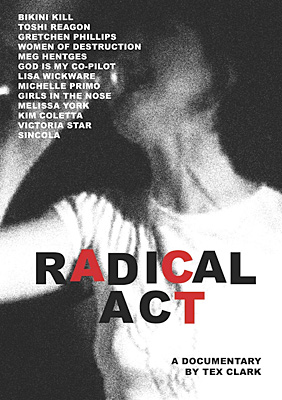
"Radical Act, a documentary by Tex Clark, was filmed back in 1995 and is about the queer/feminist music scene in the USA at that time. The documentary is simple but endearing - Clark interviewed female musicians and music journalists about the impact of their sexual and gender identity on their work. And with the likes of Vicky Starr, Meg Hentges, Toshi Reagon, Kay Turner and Gretchen Phillips there are some wonderful one-liners in their responses to that question.
Kathleen Hanna from Bikini Kill/Le Tigre is the biggest name featured in Radical Act – you can tell it was the 1990′s because she says ‘totally’ a lot in this film. Hanna is terribly charismatic and has broad appeal – in my circles she equally captured the attentions of my straight male partner (in her Bikini Kill days) and my queer female best friends (in her Le Tigre days). With Hanna involved you are pretty much guaranteed a fresh audience for this documentary as Hanna continues to draw a huge following among young feminists, but mostly Radical Act will appeal to those of us old enough to see the film as a sweet souvenir of our pasts.
The Riot Grrl movement was a fascinating era – a bunch of radical women found themselves being increasingly embraced by the punk music scene until eventually their style became a hot commodity in the commercial music industry. Much of the documentary focuses on surviving that kind of popularity with integrity and radical politics intact. At one point Vicky Starr talks about the importance of preparing for life when the public doesn’t think feminism is so cute anymore, fifteen year later and that time has well and truly come. In fact, seeing all of that optimism for feminism I experienced a kind of sadness at times while watching Radical Act.
Radical Act is being re-released (the film did some of the festival circuit back in 1996) by A Million Movies a Minute and is available for purchase or rental on-line (see below for details). With the current nostalgia for the Riot Grrl movement the time is right for Radical Act, but it is also a timely reminder that in spite of Lady Gaga and the hijacking of ‘Girl Power’ as a marketing slogan, being openly queer and feminist as a musician outside of the indie music scene is still a relatively rare occurrence today. Also, that women can so play guitar."
sábado, 23 de outubro de 2010
NO!

Feminism taught me that it was okay to talk about sex, even perhaps if you were having or about to have sex! And that things worked out better that way! Because feminism taught me that ladies matter. Even the naked ones.
Even if they are you.
— Sady Doyle (via gracetace)
sexta-feira, 22 de outubro de 2010
Gender Binary

“All decent people, male and female, are feminists. The only people who are not feminists are those who believe that women are inherently inferior or undeserving of the respect and opportunity afforded to men. Either you are a feminist or you are a sexist/misogynist. There is no box marked ‘other’.“
By Ani DiFranco
quinta-feira, 21 de outubro de 2010
Teach your son to respect WOMEN

sexta-feira, 15 de outubro de 2010
STOP DOMESTIC VIOLENCE


quinta-feira, 14 de outubro de 2010
EXCLUSIVE Ani DiFranco: “Feminism Will Save the World”
I was blessed with a feminist mom and her empowered friends who started a food co-op and were part of “Women for Downtown Buffalo.” We would always go door to door for progressive women candidates. I learned very early what it means to connect with other women, and I realized that these are the women whose respect means so much to me. I wanted the respect of the people I respect."
Written by Ani Difranco
quarta-feira, 13 de outubro de 2010
Feminism on man?


terça-feira, 12 de outubro de 2010
Dating Science: Do Feminists Make for Better Girlfriends?
Sounds crazy, right? What heterosexual woman in her right mind would dare broach the topic of feminism on a first (or second, or third…) date? Somewhere along the way, we collectively misconstrued the fight against unequal gender roles as an argument against romance. So while feminism encourages women to develop quite possibly the most attractive traits people can possess — confidence, intelligence, self-sufficiency, etc. — we’re socialized to tuck it away, lest risk frightening some poor fellow away. As a result, plenty of men and women alike embrace feminism’s basic tenets of gender equality, yet fear identifying with it directly due to its negative stigma. But closet feminists playing the dating game might be shooting themselves in the foot by not letting that light shine a little brighter.
A 2007 study from Rutgers psychologists concluded that feminism benefits women in romantic relationships as well as the men. And for an added bonus, feminist lovin’ couples also reported more satisfaction between the sheets. Win-win!
The psychologists polled roughly 600 heterosexual undergrads and older adults to compare participants’ beliefs about feminism and their relationship health. According to the survey results, men’s feminism had a stronger correlation with positive relationship health than women’s feminism or participants’ perceptions of their partners’ feminism. Therefore, a woman’s feminism doesn’t make or break the romance at all. It’s the feminist men out there who are relationship revolutionaries. After all, they identified more strongly with partner equality, which predicted greater stability and sexual satisfaction.
So maybe tossing out a Steinem reference over cocktails isn’t such a terrible idea. Because while feminists make for fabulous girlfriends, they make for even better boyfriends."
Source: sarahgraham7
What I think:
It is interesting. I can definitely see why a feminist boyfriend can lead to a better relationship. It makes me sad that a feminist girlfriend doesn’t have the same impact since guys only head workin' is the one covered by their underwear? Yeah, feminists are good in bed but not good enough to be taken seriously. Here's for you sexists, a transformed finger: .l.
segunda-feira, 11 de outubro de 2010

domingo, 10 de outubro de 2010
Citi Bank Policy (Reblogged)

1. Women tend to have two X chromosomes — you are not heard.
2. Women menstruate in public — emphasizes your femininity and deemphasizes your capability.
3. Women sit vaginally — the power position when seated at a table is to have a penis.
4. Wear panties in meetings — boxer-wearers are seen as more assertive and knowledgeable than those in lacy underthings.
5. Women have wombs — children come out of wombs. Men don’t reproduce, they conquer.
6. Ovulate — women ovulate at the smallest provocation which erodes your self-confidence. Men tend to move into sperm producing mode.
7. Women tend to smile inappropriately — an “inappropriate” smile is a smile that is on a woman’s face.
8. Observe “Rules” — rules are made to be broken by men. When women break them, it is a violation of workplace culture. When women follow them, it is self-sabotage. To be safe, avoid being a woman whenever possible.
9. Being invisible — 90% of adult humans are unable to visually perceive women. Solution: wear a bear suit.
10. Offer a female handshake — the best way to combat this is to have a man’s hand transplanted onto your wrist. Or purchase a giant foam hand at a sports stadium. These are very masculine and you are sure to be taken extremely seriously while wearing one.
sábado, 9 de outubro de 2010
Who Stole Feminism?! The Nation!
This reminds me of the older feminist/young feminist debacle online months ago. I do think we shouldn’t be separating ourselves. We all should be helping each other… united we conquer, divided we fall. Honestly, feminists can’t do SHIT* unless we all work together.
*bring true, long, widespread change.
sexta-feira, 8 de outubro de 2010
Let’s just clear something up here...
"Being a feminist does not mean you hate men.
Being a feminist does not mean you think you are the better sex.
Being a feminist does not mean you have to identify with a particular political party or religion (or atheism or agnosticism or eastern philosophy, for that matter).
Being a feminist does not mean you are necessarily pro-choice, though many pro-choice people are feminists (some might disagree with me here, and that’s okay. But I think feminism is more inclusive than it is exclusive).
Being a feminist does mean you think the sexes are equal, and that women and men are generally equally qualified to do most things. A feminist most likely agrees a woman can be a NASCAR driver and a man can be a stay-at-home dad.
Being a feminist does mean that you are against the degradation of women. You don’t want to see them raped, or beaten, or enslaved. You want women to have essential human rights.
Being a feminist does mean that you care about women’s issues, and about finding the best answers to the hardest questions that surround women (again, feminists often differ on what is best for women, but they are all trying, hopefully, in authentic manners to figure these things out).
And feminism is not an exclusively female club. Men can be feminists. Many are. My husband is one of the many.
LADIES, stop saying “you are starting to think like a feminist” or “don’t mean to sound like a feminist” as if that is a BAD thing. Because if you are saying these things, you might be unclear on the actual definition of feminism. Or, maybe you’re actually a misogynist.
(Sorry if we’re just going over the basics here, but I’m seeing a lot of ignorance on the web, still, about this issue). "
I do not agree with everything said here, but I wanted to share it anyway but if their is anything to clear up here is that you can be a feminist, beeing male or female...neither...both. Your gendre doesn't mean shit when related with your political views...
Just for the record.
quinta-feira, 7 de outubro de 2010
Pink October
quarta-feira, 6 de outubro de 2010
terça-feira, 5 de outubro de 2010
The Girl Effect: The Clock is Ticking
If you watch one video today, let this be it.
It has long been known by those in the development field that female empowerment can be one of the most powerful mechanisms by which to alleviate both the crushing depth and self-propagating symptoms of poverty.
This isn’t news - yet girls around the world, even in developed nations, continue to fall through the cracks.
Now, The Girl Effect movement seeks to leverage this into social-media-driven action. Click through to their official website and see the simple ways in which you can help to empower this army of would-be Slayerettes.
It could be as simple as fund-raising to help to pay a girl’s school fees, making a micro-loan to help fund a young woman’s business idea, or even spreading the girl effect by reposting this video.
So before you head out into the weekend, click Re-blog and pass this on. ♥
domingo, 3 de outubro de 2010
K. V. Switzer

In 1967, Kathrine Switzer, a 20 year old college student, registered to run the Boston Marathon under the name “K. V. Switzer.” When race officials discovered that K. V. was a woman, the race had already started. This picture shows perfectly-named Boston Marathon official Jock Semple attempting to physically remove Switzer from the event, reportedly shouting, “Get the hell out of my race and give me those numbers!” Switzer’s college athlete boyfriend bodychecked the race official and the pair continued running.
She successfully completed the race in 4 hours and 20 minutes, and seven years later won the New York City Marathon with a time of under 3:08.
holy fuck. 1967.
sábado, 2 de outubro de 2010

quarta-feira, 29 de setembro de 2010
Reconsidering Riot Grrrl

“Riot Grrrl would later be spoken of as girls challenging sexism within punk… In a subculture that congratulated itself for presenting an alternative, in a realm that should have been a refuge, they found more of the same crap. Boys’ efforts were lauded and girls’ were unrecognized… Objectification and sexual assault went unaddressed… Punk wasn’t really the point, though. The problems with the scene burned the girls up precisely because it echoed the way the world at large treated them.”—Girls to the Front
Now validated as an important component of third wave feminism, Riot Grrrl was a loosely organized network of various newly politicized young girls trying to find a place and voice for themselves within punk and feminism in the early 1990s. Basically, the punk scene felt too sexist, while academic feminism seemed too rigid and out of touch with the lives of young girls. We sought to forge a safe, encouraging and vibrant cross-section where punk challenged sexism, among other oppressive ills, and feminism could speak to the reality of our lives as young punk girls.
As one of the founding movers and shakers of Riot Grrrl and lead singer of the decidedly Riot Grrrl band Bratmobile, I must admit feeling somewhat anxious when asked to read and review the latest attempt to get the Riot Grrrl story “right,” Sara Marcus’ in-depth study Girls to the Front. It can be emotional and confusing to read about yourself and major events in your life by someone who wasn’t entirely there and posits it back in third person print as fact. In many ways, Marcus nails it. But, then again, can this type of rendition ever be quite right?
While minor mistakes and mixups populate the text to a certain extent, Girls to the Front seems far more accurate than any other thirdparty Riot Grrrl documentation out there. Marcus has a gift for contextualizing Riot Grrrl politically in the times in which it thrived. She makes insightful connections with our intentions, motivations and meanings that many other storytellers have missed. Complete with smooth, catchy transitions, she thoughtfully and sensitively provides interesting personalized back-stories for many of the main players and the artists who influenced them. Marcus seems to have gotten inside our heads—she really gets it, which is impressive and rare.
Related contentWomb & DoomBash Compactor: 2012: Girl Style NowThe Punk Ballerina is Now a Commander in ArtsWe’re A Happy FamilyRelated to:
riotgrrrlgirlsmarcuswerepunkfrontthereThe feeling of being excluded, dismissed, trivialized and written out of history has always been a bone of contention for marginalized people. While I’m proud to be validated in print for my contributions to the feminist continuum, I feel there are some misrepresentations in Girls to the Front that warrant mention for that very reason. Throughout the book, I sensed an underlying theme that myself and my band were not taken as seriously within the Riot Grrrl movement as, say, Bikini Kill or Heavens to Betsy. I am often referred to as “dorky,” “strange,” “weird” and, my personal favorite, “What is that??” Perhaps that’s something I need to come to terms with, and I know it’s not a competition, but am I really that out there? Marcus also characterizes my band as infantile and simplistic and insists that “Bratmobile had always been a relatively low-intensity band, something to do on school breaks,” when in reality, that band was the embodiment of our socio-political coming of age that placed us in the vortex of an incredibly influential time for music and feminism. While I understand the point she’s trying to make, that we proved you didn’t have to be mainstream cool or a professional musician to achieve what we did, after a while these impressions felt a bit dismissive.
Furthermore, her sole mention of the influential queer bassist/guitarist/ homocore zinester Donna Dresch in the book as simply “Tobi [Vail]’s friend from high school” left something to be desired. Donna’s early and continual encouragement and example set the stage for many a Riot Grrrl to follow.
I was also surprised to read that my telling of an incident where I threw a bloody tampon into the annoying crowd of a Washington, D.C., Fugazi show was presented as a (partial) lie. Many of Fugazi’s fans on the Mall were harassing Riot Grrrls throughout the day and behaving like jocks in the crowd. When these same jerks started singing along to the pro-woman song “Reclamation,” it made me sick. My tampon was overdue for a change and there were no bathrooms in sight. I envisioned my bloody tampon sailing into the mouth of one of these hypocritical jock fans, and it made my day. It’s too bad I can’t throw or aim well and that my tampon barely missed Ian MacKaye, one of my old friends and comrades. I was there, I did it and I know how it happened and what my intentions were. Regardless of the interpretation of any onlookers or MacKaye, who gets to tell this story? Who has their words taken seriously? Whose version goes down in history?
Sara Marcus takes some liberties in her prosaic descriptions of Riot Grrrl and our intentions. The problem is that most often opinions coming from the people Marcus interviewed are stated as fact and not placed more appropriately in quotes. Girls to the Front often blurs the lines between her interpretations and musings and the words and intentions of her subjects. It’s impossible to tell who really said what, what they really meant and wherein lies the truth. I believe there are multiple truths in the telling of Riot Grrrl, but perhaps that multiplicity cannot be thoroughly conveyed within the framework of a third-person retelling.
Ultimately, Girls to the Front is a painstakingly researched and wellthought-out tribute to a punk feminist era Sara Marcus clearly holds dear. I greatly appreciate the hard work and interpretive skill she put into a story of which I am part, and it should be heralded as an uncannily insightful revelation of the motivations and inner-workings of Riot Grrrl.
Allison Wolfe was born an identical twin in Memphis, Tenn. She grew up in Olympia, Wash., lived in Washington, D.C., for a long time and currently resides in Los Angeles, where she is considering working on an oral history of Riot Grrrl. Wolfe is a cofounder of Riot Grrrl and Ladyfest, as well as a singer who has been in Bratmobile, Cold Cold Hearts, Deep Lust and Partyline.
By Allison Wolfe